What’s all this commotion?
During the early part of the service the church may seem to be in a hubbub, with people praying before icons, venerating them, and lighting candles, even though prayers are already being offered. What’s going on here?
Orthodox worship often flows from one service into another. In the Russian tradition, the Hours are ordinarily read before the Divine Liturgy; Vigil or Vespers is commonly served the evening before. When you arrive for Liturgy, preparatory prayers may already be underway. This does not mean that you have missed the beginning of the Liturgy.
Worshippers also offer private prayers as they enter the church. This can be distracting to newcomers, but soon you begin to recognize it as an expression of a faith that is not merely formal but very personal. Try to arrive a little early. During the Gospel reading and other especially solemn moments, pause quietly rather than walking about. You are welcome to ask someone for help.
At St. Catherine in Lubbock, our meeting place and service times will be announced as they are confirmed. Please check our calendar or contact us before making your first visit.
Stand up, stand up for Jesus.
In the Orthodox tradition, the faithful stand up for nearly the entire service. Really. In some Orthodox churches, there won’t even be any chairs, except a few scattered at the edges of the room for those who need them. Expect variation in practice: some churches, especially those that bought already-existing church buildings, will have well-used pews. In any case, if you find the amount of standing too challenging you’re welcome to take a seat. No one minds or probably even notices. Long-term standing gets easier with practice.
We worship with our whole being: we stand, we bow, and we prostrate. These Biblical postures each contribute to the prayers we lift together. Participate as you are able; you are welcome to sit when you need to.
In this sign.
To say that we make the sign of the cross frequently would be an understatement. We sign ourselves whenever the Trinity is invoked, whenever we venerate the cross or an icon, and on many other occasions in the course of the Liturgy. But people aren’t expected to do everything the same way. Some people cross themselves three times in a row, and some finish by sweeping their right hand to the floor. On first entering a church people may come up to an icon, make a “metania”—crossing themselves and bowing with right hand to the floor—twice, then kiss the icon, then make one more metania. This becomes familiar with time, but at first it can seem like secret-handshake stuff that you are sure to get wrong. Don’t worry, you don’t have to follow suit.
We cross with our right hands from right to left (push, not pull), the opposite of Roman Catholics and high-church Protestants. We hold our hands in a prescribed way: thumb and first two fingertips pressed together, last two fingers pressed down to the palm. Here as elsewhere, the Orthodox impulse is to make everything we do reinforce the Faith. Can you figure out the symbolism? (Three fingers together for the Trinity; two fingers brought down to the palm for the two natures of Christ, and his coming down to earth.) This, too, takes practice. A beginner’s imprecise arrangement of fingers won’t get you denounced as a heretic.
What, no kneelers?
Standing is the usual posture of Orthodox worship. At certain services we also make prostrations: we kneel, place our hands on the floor, and touch our foreheads down between our hands. The whole body joins in prayer.
Sometimes we do this and get right back up again, as during the prayer of St. Ephraim the Syrian, which is used frequently during Great Lent. In the Church’s usual practice, Sundays and the Paschal season are times for standing rather than penitential kneeling or prostrations. The posture you see depends on the service and season.
Not everyone is physically able to prostrate. A bow, standing quietly, or remaining seated when needed is perfectly understandable. As a visitor, you do not have to imitate every movement. Modest, comfortable clothing and shoes will help you feel at ease.
One former Episcopal priest said that seeing people prostrate themselves was one of the things that made him most eager to become Orthodox. He thought, “That’s how we should be before God.”
With Love and Kisses
We kiss things. When we first come into the church, we may venerate icons by making the sign of the cross and kissing them. You may also see people receive a blessing and kiss the priest’s hand, or come forward to venerate the cross at the end of a service. When we talk about “venerating” something, we often mean crossing ourselves and kissing it. This is an expression of love and honor; worship belongs to God alone.
The apostolic greeting, “Greet one another with a kiss of love” (1 Peter 5:14), also has a place in Orthodox life. At the Liturgy in the Russian tradition, the liturgical kiss of peace is ordinarily exchanged among the clergy in the altar. Do not expect a moment when every visitor must exchange kisses with everyone nearby.
The traditional greeting is “Christ is in our midst,” with the response, “He is and shall be.” Customs vary, and you can learn them gradually. You are welcome to observe quietly; you do not have to venerate an icon or know every greeting on your first visit. Chatting and fellowship is for after the service.
Blessed bread and consecrated bread.
Holy Communion is for Orthodox Christians who are in communion with the Church and have prepared with prayer, fasting, and confession under the guidance of their priest. If you are an Orthodox visitor who hopes to receive, please speak with the priest beforehand. Here’s how it works: the round communion loaf, baked by a parishioner, is imprinted with a seal. In the preparation service before the Liturgy, the priest cuts out a section of the seal and sets it aside; it is called the “Lamb”. The rest of the bread is cut up and placed in a large basket, and blessed by the priest.
During the eucharistic prayer, the Lamb is consecrated to be the Body of Christ, and the chalice of wine is consecrated as His Blood. Here’s the surprising part: the priest places the “Lamb” in the chalice with the wine. When we receive communion, we file up to the priest, standing and opening our mouths wide while he gives us a fragment of the wine-soaked bread from a golden spoon. He also prays over us, calling us by our first name or the saint-name which we chose when we were baptized or chrismated (received into the church by anointing with blessed oil).
You may also see blessed bread, called antidoron, distributed after the service. This is distinct from Holy Communion: it is blessed, but it is not the consecrated Body of Christ. Customs concerning its distribution vary. Please ask the priest or someone assisting before taking it, especially if you are not Orthodox.
Visitors are sometimes offended that they are not allowed to receive communion. Orthodox believe that receiving communion is broader than me-and-Jesus; it acknowledges faith in historic Orthodox doctrine, obedience to a particular Orthodox bishop, and a commitment to a particular Orthodox worshipping community. There’s nothing exclusive about this; everyone is invited to make this commitment to the Orthodox Church. But the Eucharist is the Church’s treasure, and it is reserved for those who have united themselves with the Church. An analogy could be to reserving marital relations until after the wedding.
We also handle the Eucharist with more gravity than many denominations do, further explaining why we guard it from common access. We believe it is truly the Body and Blood of Christ. Preparation includes confession, prayer, reconciliation with others, and the Eucharistic fast. The usual fast is from food and drink from midnight before Communion; the priest gives pastoral guidance for individual circumstances. Please discuss preparation with him rather than trying to work it out alone.
This leads to the general topic of fasting. When newcomers learn of the Orthodox practice, their usual reaction is, “You must be kidding.” The Church appoints fasting on most Wednesdays and Fridays and during four fasting seasons, the longest being Great Lent before Pascha (Easter). What is permitted varies with the day, feast, and pastoral guidance. Here, as elsewhere, expect great variation. With the counsel of their priest, people decide to what extent they can keep these fasts, both physically and spiritually—attempting too much rigor too soon breeds frustration and defeat. Nobody’s fast is anyone else’s business. As St. John Chrysostom says in his beloved Paschal sermon, everyone is welcomed to the feast whether they fasted or not: “You sober and you heedless, honor the day…Rejoice today, both you who have fasted and you who have disregarded the fast.”
The important point is that the fast is not rigid rules that you break at grave risk, nor is it a punishment for sin. Fasting is exercise to stretch and strengthen us, medicine for our souls’ health. In consultation with your priest as your spiritual doctor, you can arrive at a fasting schedule that will stretch but not break you. Next year you may be ready for more. In fact, as time goes by, and as they experience the camaraderie of fasting together with a loving community, most people discover they start relishing the challenge.
Where’s the General Confession?
In our experience, we don’t have any general sins; they’re all quite specific. There is no complete confession-prayer in the Liturgy. Orthodox are expected to be making regular, private confession to their priest.
The role of the pastor is much more that of a spiritual father than it is in other denominations. He is not called by his first name alone, but referred to as “Father Firstname.” If a priest is married, you may hear his wife addressed as “Matushka” in the Russian tradition. Other traditions use “Khouria” or “Presbytera.” These titles express affection and respect.
Another difference you may notice is in the Nicene Creed, which may be said or sung, depending on the parish. If we are saying that the Holy Spirit proceeds from the Father, and you from force of habit add, “and the Son,” you will be alone. The “filioque” was added to the Creed some six hundred years after it was written, and we adhere to the original. High-church visitors will also notice that we don’t bow or genuflect during the “and was incarnate.” Nor do we restrict our use of “Alleluia” during Lent (when the sisters at one Episcopal convent are referring to it as “the ‘A’ word”); in fact, during Matins in Lent, the Alleluias are more plentiful than ever.
Music, music, music.
Much of the service is sung or chanted. In the Russian Orthodox tradition, worship is a cappella, without instrumental accompaniment. Singers lead the prayers and hymns, and the level of congregational participation varies from parish to parish. The style of music varies as well, from simple chant to four-part harmony.
This constant singing is a little overwhelming at first; it feels like getting on the first step of an escalator and being carried along in a rush until you step off at the end of the service. It has been fairly said that the liturgy is one continuous song.
What keeps this from being exhausting is that it’s pretty much the same song every week. Relatively little changes from Sunday to Sunday; the same prayers and hymns appear in the same places, and before long you know it by heart. Then you fall into the presence of God in a way you never can when flipping from prayer book to bulletin to hymnal.
Making editors squirm.
Is there a concise way to say something? Can extra adjectives be deleted? Can the briskest, most pointed prose be boiled down one more time to a more refined level? Then it’s not Orthodox worship. If there’s a longer way to say something, the Orthodox will find it. In Orthodox worship, more is always more, in every area including prayer. When the priest or deacon intones, “Let us complete our prayer to the Lord,” expect to still be standing there fifteen minutes later.
Most Sundays the Church serves the Divine Liturgy of St. John Chrysostom. On certain days, including the Sundays of Great Lent, we use the Liturgy of St. Basil, whose Eucharistic prayers are longer. There is time to listen, repeat, and enter into the prayer rather than rush through it.
Allow yourself time for worship and for meeting people afterward. Children are welcome. Parents may step outside with a little one who needs a moment and return when ready. Once our service schedule is confirmed, we can help you plan your visit.
Our Champion Leader
A constant feature of Orthodox worship is veneration of the Virgin Mary, the “champion leader” of all Christians. We often address her as “Theotokos,” which means “Mother of God.” In providing the physical means for God to become man, she made possible our salvation.
But though we honor her, as Scripture foretold (“All generations will call me blessed,” Luke 1:48), this doesn’t mean that we think she or any of the other saints have magical powers or are demi-gods. When we sing “Holy Theotokos, save us,” we don’t mean that she grants us eternal salvation, but that we seek her prayers for our protection and growth in faith. Just as we ask for each other’s prayers, we ask for the prayers of Mary and other saints as well. They’re not dead, after all, just departed to the other side. Icons surround us to remind us of all the saints who are joining us invisibly in worship.
The three doors.
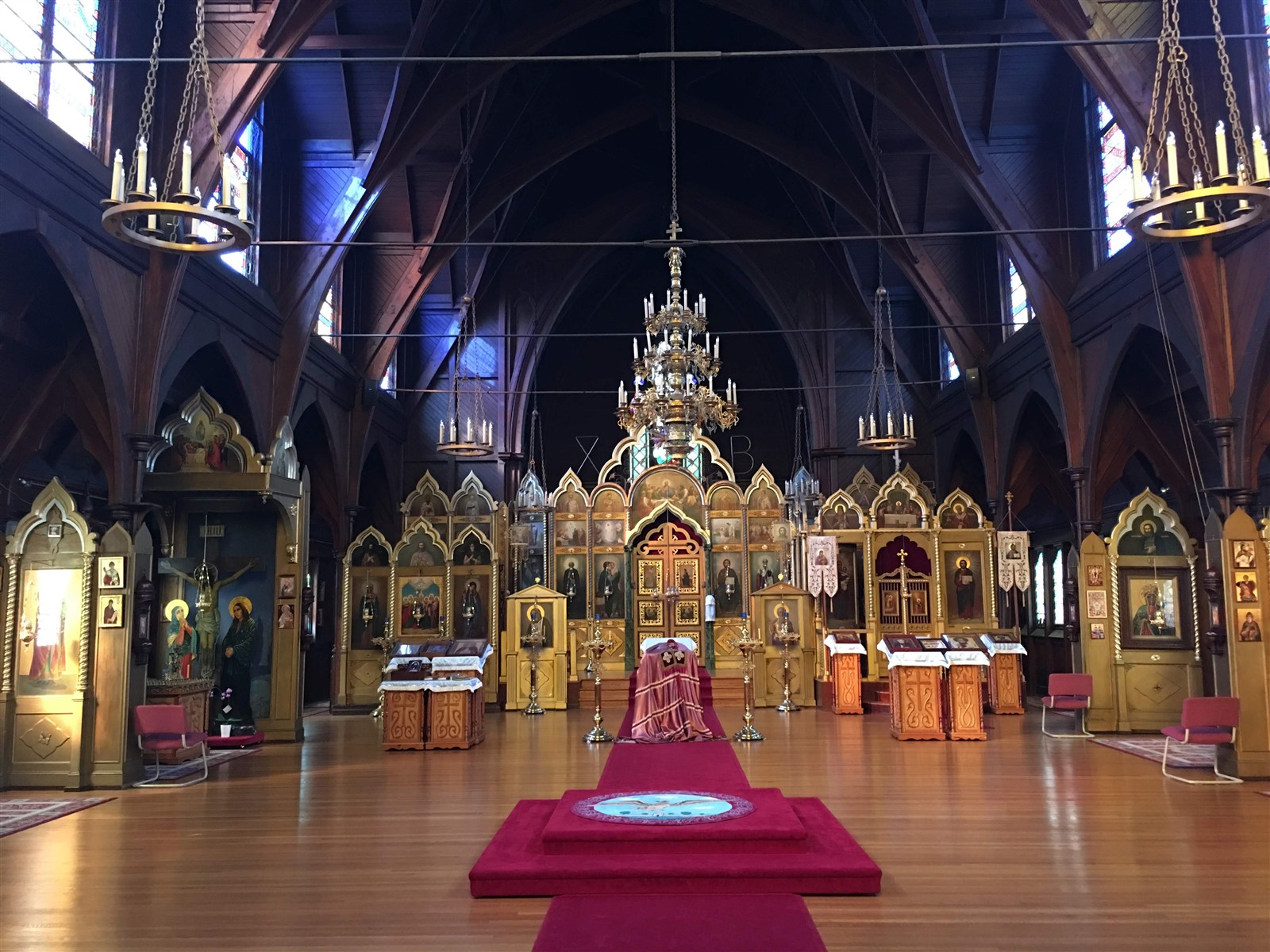
Orthodox churches ordinarily have an iconostasis before the altar; in a newly forming mission it may be quite simple. “Iconostasis” means “icon-stand”, and it can be as simple as a large image of Christ on the right and a corresponding image of the Virgin and Child on the left. In a more established church, the iconostasis may be a literal wall, adorned with icons. Some versions shield the altar from view, except when the central doors stand open.
The basic set-up of two large icons creates, if you use your imagination, three doors. The central one, in front of the altar itself, is called the “Holy Doors” or “Royal Doors,” because there the King of Glory comes out to the congregation in the Eucharist. The Holy Doors are used by the clergy at appointed moments in the services.
The openings on the other sides of the icons, if there is a complete iconostasis, have doors with icons of angels; they are termed the “Deacon’s Doors.” The side doors are used by clergy and those blessed to assist in the altar. The altar area is not a place to explore on your own; please ask before entering.
The ordained ministries of bishop, priest, and deacon are held by men. Women and men contribute throughout the life of the Church through singing, teaching, iconography, hospitality, service, and other responsibilities. The icons of the Mother of God and the holy women remind us how deeply their lives are honored.
Where does an American fit in?
You may see Orthodox churches described as Russian, Greek, Romanian, Antiochian, Serbian, and more. If you do not share that heritage, is there a place for you?
Yes. These names often tell you something about a church’s historical roots and the bishops under whose care it serves. They do not make ethnicity a condition of belonging. The Orthodox faith is the apostolic faith, offered to people of every background.
St. Catherine Orthodox Mission in Lubbock is under the omophorion of His Grace, Bishop Spyridon, in the Diocese of Chicago and Mid-America of the Russian Orthodox Church Outside of Russia (ROCOR). Our inheritance is rooted in the Russian Orthodox tradition, and our welcome extends to all who wish to encounter Christ and His Church.
“There is neither Jew nor Greek, there is neither bond nor free, there is neither male nor female: for ye are all one in Christ Jesus” (Galatians 3:28). Whether you grew up Orthodox, are exploring Christianity, or are simply curious, you are welcome to come and see. Together we seek to grow through worship, prayer, hospitality, and the life of the Gospel here in West Texas.
Orthodoxy seems startlingly different at first, but as the weeks go by it gets to be less so. It will begin to feel more and more like home, and will gradually draw you into your true home, the Kingdom of God. I hope that your first visit to an Orthodox church will be enjoyable, and that it won’t be your last.